Holi होली
Festival of Colours
The spring festival of colours, played on the day after Holika Dahan (Chaitra Krishna Pratipada).
About Holi
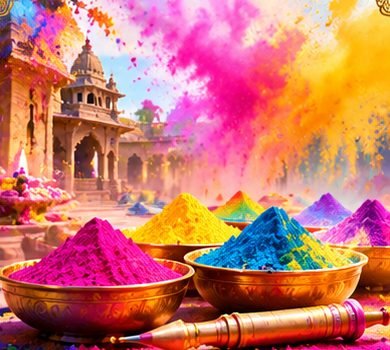
Holi welcomes spring with coloured powders, water, music and shared sweets. It is celebrated the morning after Holika Dahan, the bonfire of Phalguna Purnima.
The festival recalls the devotion of Prahlada and the burning of Holika, and in Braj it is closely linked with the playful Holi of Radha and Krishna, celebrated over many days in Mathura, Vrindavan, Barsana and Nandgaon.
Religious significance
Holika Dahan symbolises the protection of the devotee and the destruction of adharma; the play of colours on the following day expresses joy, renewal and the dissolving of social barriers.
- Also known as
- Dhulandi, Rangwali Holi, Dol Jatra, Basant Utsav
- Sanskrit
- होलिकोत्सवः
- Deity
- Krishna, Vishnu (Narasimha)
- Tradition
- Hindu
- Regions
- All India
- Season
- Vasanta (spring)
- Categories
- Major Hindu Festivals, Vaishnava Festivals, Seasonal Festivals
- Observance rule
- +1 day(s) relative to holika-dahan.
History and Origin
This section is being prepared and reviewed by the Vedicsiddhanta editorial team. Subscribe to be notified when it is published.
Festival Stories
Puranic, Itihasa and traditional narratives. Variants are labelled with their source and tradition.
This section is being prepared and reviewed by the Vedicsiddhanta editorial team. Subscribe to be notified when it is published.
Vrat and Upvas
This section is being prepared and reviewed by the Vedicsiddhanta editorial team. Subscribe to be notified when it is published.
Health note: those who are unwell, pregnant, elderly or on medication should adapt fasting with medical advice; traditions themselves permit exemptions.
Vrat Katha
Holi Katha — Prahlada and Holika होली कथा — प्रह्लाद और होलिका
Editorial retelling of the story recalled at Holika Dahan. Replace with the approved full text before publication.
दैत्यराज हिरण्यकशिपु को वरदान का अहंकार था और वह स्वयं को ही ईश्वर मनवाना चाहता था। उसका पुत्र प्रह्लाद भगवान विष्णु का अनन्य भक्त था। पिता ने अनेक प्रकार से उसे डराया और कष्ट दिए, पर प्रह्लाद की भक्ति अडिग रही।
अन्त में हिरण्यकशिपु ने अपनी बहन होलिका की सहायता ली, जिसे अग्नि से न जलने का वर प्राप्त था। होलिका प्रह्लाद को गोद में लेकर अग्नि में बैठ गई। भगवान की कृपा से प्रह्लाद सुरक्षित रहे और होलिका भस्म हो गई। इसी स्मृति में फाल्गुन पूर्णिमा को होलिका दहन किया जाता है।
बाद में भगवान विष्णु ने नृसिंह रूप में प्रकट होकर हिरण्यकशिपु का अन्त किया और भक्त की रक्षा की।
The demon-king Hiraṇyakaśipu, proud of his boons, demanded to be worshipped as God. His son Prahlāda remained devoted to Lord Viṣṇu despite threats and torments.
Finally the king enlisted his sister Holikā, who was protected from fire. She sat in a pyre with Prahlāda in her lap; by the Lord’s grace Prahlāda was unharmed and Holikā was consumed. Holikā Dahan on Phālguna Pūrṇimā recalls this.
Later Viṣṇu appeared as Narasiṃha and ended Hiraṇyakaśipu, protecting his devotee.
Recited or remembered at the Holika Dahan bonfire on Phalguna Purnima.
Source: Prahlāda and Narasiṃha: Bhāgavata Purāṇa, Skandha 7 (chs. 5–9); the Holikā episode is preserved in later Purāṇic and folk tradition. Editorial retelling. · Rights: Original Vedicsiddhanta content · Reviewed by Rocky Jamwal
Puja Vidhi
Step-by-step guidance. Follow the practice of your family tradition and guru where it differs.
This section is being prepared and reviewed by the Vedicsiddhanta editorial team. Subscribe to be notified when it is published.
Mantra Sangrah
This section is being prepared and reviewed by the Vedicsiddhanta editorial team. Subscribe to be notified when it is published.
Stotra Sangrah
This section is being prepared and reviewed by the Vedicsiddhanta editorial team. Subscribe to be notified when it is published.
Aarti Sangrah
This section is being prepared and reviewed by the Vedicsiddhanta editorial team. Subscribe to be notified when it is published.
Puja Samagri
Quantities are shown only where verified; traditional alternatives are listed.
This section is being prepared and reviewed by the Vedicsiddhanta editorial team. Subscribe to be notified when it is published.
Muhurat & Panchang — New Delhi, 2027
+1 day(s) relative to holika-dahan.
| Date | Tithi | Tithi window | Muhurat | Sunrise / Sunset | Status |
|---|---|---|---|---|---|
| Tue, 23 Mar | Krishna Pratipada Chaitra |
— | — | 06:22 / 18:33 | Indicative |
Times are local to New Delhi (Asia/Kolkata). “Indicative” values are calculated by the Vedicsiddhanta engine (Lahiri ayanamsa, sunrise with standard refraction) and await approval by our Panchang reviewer; “Verified” values have been reviewed. Observance can differ by tradition and region — follow your family tradition or local temple where they differ.
Vedic Astronomy and Jyotisha Significance
Astronomical facts
- Calendar rule+1 day(s) relative to holika-dahan.
- Moon–Sun elongation at sunrise187.7° — Krishna Pratipada (100% illuminated)
- Sun (sidereal, Lahiri)Mina 7.9°
- Moon nakshatra at sunriseHasta
- Lunar monthPhalguna (Amanta) · Chaitra (Purnimanta)
A tithi is the interval in which the Moon gains 12° of longitude on the Sun; the lunar month is named from the solar sign at the new moon that opens it.
Traditional & calendrical interpretation
Holika Dahan is performed on Phalguna Purnima (full moon) during Pradosh, avoiding Bhadra (Vishti karana). Dhulandi follows on Chaitra Krishna Pratipada, the start of the Purnimanta month of Chaitra.
Regional Celebrations
Dol Jatra / Dol Purnima in Bengal and Odisha; Lathmar Holi in Barsana and Nandgaon; Hola Mohalla among Sikhs in Anandpur Sahib; Shigmo in Goa.
References & Further Reading
Primary and secondary sources used for this festival guide.
This section is being prepared and reviewed by the Vedicsiddhanta editorial team. Subscribe to be notified when it is published.