Makar Sankranti मकर संक्रांति
Sun’s Transition into Makara
The Sun’s entry into sidereal Makara (Capricorn), observed with holy baths, charity, sesame and jaggery, kites and harvest celebrations.
About Makar Sankranti
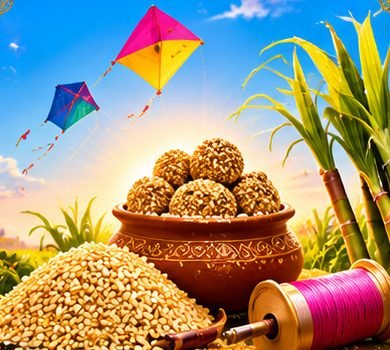
Makar Sankranti is one of the few major Hindu festivals fixed by the solar calendar. It marks the Sun's entry into sidereal Makara and is celebrated with holy dips, charity (daan), sesame–jaggery sweets and, in many regions, kite flying.
It is a harvest festival across India: Pongal in Tamil Nadu, Uttarayan in Gujarat, Maghi in Punjab, Bhogali Bihu in Assam and Khichdi in Uttar Pradesh and Bihar.
- Also known as
- Uttarayan, Maghi, Khichdi Parv
- Sanskrit
- मकरसङ्क्रान्तिः
- Deity
- Surya
- Tradition
- Hindu
- Regions
- All India
- Categories
- Major Hindu Festivals, Seasonal Festivals, Solar and Lunar Observances
- Observance rule
- Solar observance: the Sun's entry (sankranti) into sidereal Makara (Lahiri ayanamsa).
History and Origin
This section is being prepared and reviewed by the Vedicsiddhanta editorial team. Subscribe to be notified when it is published.
Festival Stories
Puranic, Itihasa and traditional narratives. Variants are labelled with their source and tradition.
This section is being prepared and reviewed by the Vedicsiddhanta editorial team. Subscribe to be notified when it is published.
Vrat and Upvas
This section is being prepared and reviewed by the Vedicsiddhanta editorial team. Subscribe to be notified when it is published.
Health note: those who are unwell, pregnant, elderly or on medication should adapt fasting with medical advice; traditions themselves permit exemptions.
Vrat Katha
This section is being prepared and reviewed by the Vedicsiddhanta editorial team. Subscribe to be notified when it is published.
Puja Vidhi
Step-by-step guidance. Follow the practice of your family tradition and guru where it differs.
This section is being prepared and reviewed by the Vedicsiddhanta editorial team. Subscribe to be notified when it is published.
Mantra Sangrah
Gayatri Mantra गायत्री मन्त्र
- Meaning (English)
Om. Earth, atmosphere, heaven. We meditate upon that adorable radiance of the divine Savitr; may he inspire our intellects.
- अर्थ (हिन्दी)
ॐ। भू, भुवः, स्वः। हम सविता देव के उस वरणीय तेज का ध्यान करते हैं; वे हमारी बुद्धि को प्रेरित करें।
- Explanation (commentary)
The mantra is in the gāyatrī metre (three lines of eight syllables); the vyāhṛtis "bhūr bhuvaḥ svaḥ" are prefixed in ritual recitation. It is recited at sandhyā and is especially associated with solar observances.
- Pronunciation
- Recite slowly with clear syllables: va-re-ṇ-yam, bhar-go, pra-co-da-yāt.
- Japa count
- 108 (one mālā), traditionally
Author / attributed to: Ṛṣi Viśvāmitra · Source: Ṛgveda 3.62.10 (Viśvāmitra); vyāhṛtis per Taittirīya Āraṇyaka usage · Rights: Public domain · Reviewed by Rocky Jamwal
Stotra Sangrah
This section is being prepared and reviewed by the Vedicsiddhanta editorial team. Subscribe to be notified when it is published.
Aarti Sangrah
This section is being prepared and reviewed by the Vedicsiddhanta editorial team. Subscribe to be notified when it is published.
Puja Samagri
Quantities are shown only where verified; traditional alternatives are listed.
This section is being prepared and reviewed by the Vedicsiddhanta editorial team. Subscribe to be notified when it is published.
Muhurat & Panchang — New Delhi, 2027
Solar observance: the Sun's entry (sankranti) into sidereal Makara (Lahiri ayanamsa).
| Date | Tithi | Tithi window | Muhurat | Sunrise / Sunset | Status |
|---|---|---|---|---|---|
| Fri, 15 Jan | Shukla Saptami Pausha |
— | Punya Kaal (indicative): 07:15–17:46 | 07:15 / 17:46 | Indicative |
| Sankranti moment: Jan 14 21:13 (Asia/Kolkata). Sankranti falls after sunset so the Punya Kaal and observance move to the next day. | |||||
Times are local to New Delhi (Asia/Kolkata). “Indicative” values are calculated by the Vedicsiddhanta engine (Lahiri ayanamsa, sunrise with standard refraction) and await approval by our Panchang reviewer; “Verified” values have been reviewed. Observance can differ by tradition and region — follow your family tradition or local temple where they differ.
Vedic Astronomy and Jyotisha Significance
Astronomical facts
- Calendar ruleSolar observance: the Sun's entry (sankranti) into sidereal Makara (Lahiri ayanamsa).
- Moon–Sun elongation at sunrise80.5° — Shukla Saptami (42% illuminated)
- Sun (sidereal, Lahiri)Makara 0.4°
- Moon nakshatra at sunriseRevati
- Lunar monthPausha (Amanta) · Pausha (Purnimanta)
A tithi is the interval in which the Moon gains 12° of longitude on the Sun; the lunar month is named from the solar sign at the new moon that opens it.
Traditional & calendrical interpretation
A solar observance: the moment the Sun’s sidereal longitude (Lahiri) reaches 270°. Because the sidereal zodiac drifts against the seasons, the festival now falls around 14–15 January, about three weeks after the December solstice. If the sankranti occurs after sunset, the Punya Kaal moves to the next day.
Sankranti and the sidereal solar months संक्रान्ति
Why Makar Sankranti falls in mid-January, weeks after the winter solstice.
- Concept
- Sankranti, ayanamsa
- Calculation notes (facts)
A saṅkrānti is the moment the Sun enters a sidereal rāśi. Indian calendars measure the zodiac from a fixed-star reference; the difference from the tropical zodiac (the ayanāṃśa, about 24° by the Lahiri value) grows by roughly 50″ a year because of precession. Hence Makara Saṅkrānti now falls around 14–15 January although the December solstice — the true northward turn of the Sun — occurs about 21 December.
- Traditional / Jyotisha interpretation (labelled)
Tradition still treats Makara Saṅkrānti as the beginning of Uttarāyaṇa and a most auspicious time for snāna and dāna.
Source: Rashtriya Panchang; IAU precession model; editorial explanation · Rights: Original Vedicsiddhanta content · Reviewed by Rocky Jamwal
Regional Celebrations
This section is being prepared and reviewed by the Vedicsiddhanta editorial team. Subscribe to be notified when it is published.
References & Further Reading
Primary and secondary sources used for this festival guide.
This section is being prepared and reviewed by the Vedicsiddhanta editorial team. Subscribe to be notified when it is published.