Ram Navami राम नवमी
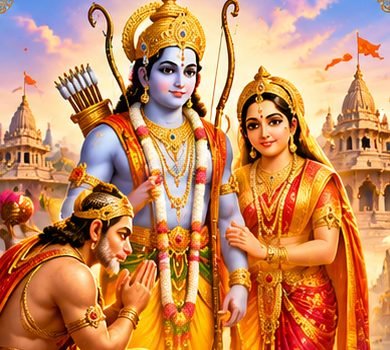
Birth of Lord Rama
The birth anniversary of Shri Rama on Chaitra Shukla Navami, worshipped at midday (Madhyahna).
About Ram Navami
Ram Navami celebrates the appearance of Shri Rama, the seventh avatara of Vishnu, to King Dasharatha and Queen Kausalya in Ayodhya. The Valmiki Ramayana places his birth on Chaitra Shukla Navami with the Moon in Punarvasu.
Devotees fast, recite the Ramayana and Ramcharitmanas, and perform the birth celebration at midday. It concludes Chaitra Navratri.
- Also known as
- Rama Navami, Shri Ram Janmotsav
- Sanskrit
- श्रीरामनवमी
- Deity
- Rama
- Tradition
- Vaishnava / Hindu
- Regions
- All India
- Categories
- Major Hindu Festivals, Vaishnava Festivals, Vrat & Upvas
- Observance rule
- Chaitra Shukla Navami (Amanta) — Chaitra Shukla Navami (Purnimanta); observed when the tithi prevails at madhyahna muhurat.
History and Origin
This section is being prepared and reviewed by the Vedicsiddhanta editorial team. Subscribe to be notified when it is published.
Festival Stories
Puranic, Itihasa and traditional narratives. Variants are labelled with their source and tradition.
This section is being prepared and reviewed by the Vedicsiddhanta editorial team. Subscribe to be notified when it is published.
Vrat and Upvas
This section is being prepared and reviewed by the Vedicsiddhanta editorial team. Subscribe to be notified when it is published.
Health note: those who are unwell, pregnant, elderly or on medication should adapt fasting with medical advice; traditions themselves permit exemptions.
Vrat Katha
This section is being prepared and reviewed by the Vedicsiddhanta editorial team. Subscribe to be notified when it is published.
Puja Vidhi
Step-by-step guidance. Follow the practice of your family tradition and guru where it differs.
This section is being prepared and reviewed by the Vedicsiddhanta editorial team. Subscribe to be notified when it is published.
Mantra Sangrah
Shri Rama Taraka Mantra श्रीराम तारक मन्त्र
- Meaning (English)
Victory to Śrī Rāma.
Source: Traditional; popularised by Samartha Rāmadāsa (17th c.) · Rights: Public domain · Reviewed by Rocky Jamwal
Stotra Sangrah
This section is being prepared and reviewed by the Vedicsiddhanta editorial team. Subscribe to be notified when it is published.
Aarti Sangrah
This section is being prepared and reviewed by the Vedicsiddhanta editorial team. Subscribe to be notified when it is published.
Puja Samagri
Quantities are shown only where verified; traditional alternatives are listed.
This section is being prepared and reviewed by the Vedicsiddhanta editorial team. Subscribe to be notified when it is published.
Muhurat & Panchang — New Delhi, 2027
Chaitra Shukla Navami (Amanta) — Chaitra Shukla Navami (Purnimanta); observed when the tithi prevails at madhyahna muhurat.
| Date | Tithi | Tithi window | Muhurat | Sunrise / Sunset | Status |
|---|---|---|---|---|---|
| Thu, 15 Apr | Shukla Navami Chaitra |
Apr 14, 15:24 → Apr 15, 13:21 | Madhyahna Muhurat: 11:04–13:21 | 05:56 / 18:46 | Indicative |
Times are local to New Delhi (Asia/Kolkata). “Indicative” values are calculated by the Vedicsiddhanta engine (Lahiri ayanamsa, sunrise with standard refraction) and await approval by our Panchang reviewer; “Verified” values have been reviewed. Observance can differ by tradition and region — follow your family tradition or local temple where they differ.
Vedic Astronomy and Jyotisha Significance
Astronomical facts
- Calendar ruleChaitra Shukla Navami (Amanta) — Chaitra Shukla Navami (Purnimanta); observed when the tithi prevails at madhyahna muhurat.
- Moon–Sun elongation at sunrise103.9° — Shukla Navami (62% illuminated)
- Sun (sidereal, Lahiri)Mesha 0.6°
- Moon nakshatra at sunrisePushya
- Lunar monthChaitra (Amanta) · Chaitra (Purnimanta)
A tithi is the interval in which the Moon gains 12° of longitude on the Sun; the lunar month is named from the solar sign at the new moon that opens it.
Traditional & calendrical interpretation
Chaitra Shukla Navami; the Madhyahna (midday) portion of the day is considered the time of Rama’s birth, so the observance day is chosen by the Navami that prevails at midday.
Tithi — the lunar day तिथि
Why festival days do not line up with civil days.
- Concept
- Tithi
- Calculation notes (facts)
A tithi is the time taken by the Moon to gain 12° of longitude on the Sun. A lunar month therefore has 30 tithis — 15 in the bright fortnight (Śukla) and 15 in the dark fortnight (Kṛṣṇa). Because the Moon’s speed varies, a tithi lasts roughly 19 to 26 hours, so a tithi can span two sunrises (vṛddhi) or none (kṣaya).
The tithi “of the day” is conventionally the one prevailing at local sunrise, but each festival has its own rule — e.g. Rāma Navamī at midday, Janmāṣṭamī at midnight, Dīpāvalī at pradoṣa.
- Traditional / Jyotisha interpretation (labelled)
Each tithi has a presiding deity and traditional suitability for particular rites, as described in Muhūrta texts.
Source: Sūrya Siddhānta; Rashtriya Panchang conventions; editorial explanation · Rights: Original Vedicsiddhanta content · Reviewed by Rocky Jamwal
Regional Celebrations
This section is being prepared and reviewed by the Vedicsiddhanta editorial team. Subscribe to be notified when it is published.
References & Further Reading
Primary and secondary sources used for this festival guide.
This section is being prepared and reviewed by the Vedicsiddhanta editorial team. Subscribe to be notified when it is published.