

This article is part of a series: Decoding past-life karma through the birth chart
Part 1: How to Unlock Your Pending Karmas of Past Life from the Natal Chart (the six techniques) (you are here)
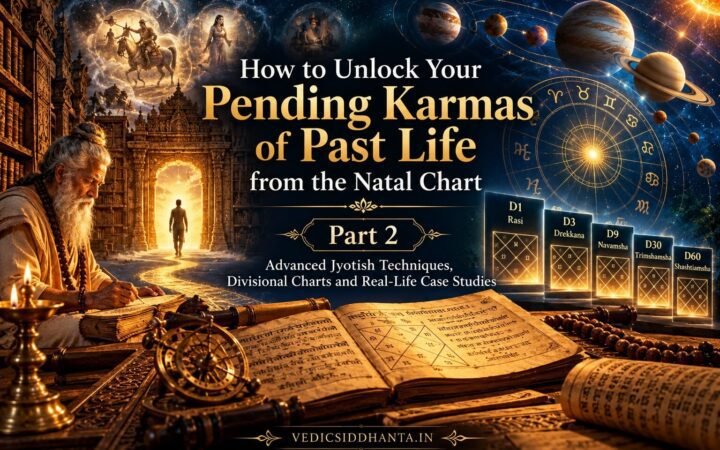
Part 2: Scriptural foundations, houses, planets and divisional charts — the Gītā and Upaniṣads on rebirth, what classical Jyotiṣa says about each technique, FAQs and editor’s notes on this article.
Understanding Past-Life Karma in Vedic Astrology
According to traditional Vedic astrology, the karma accumulated through previous lives is considered one of the factors that may influence circumstances in the present life. This understanding is based on the broader Hindu philosophical concepts of karma, rebirth, and the consequences of one’s actions.
Within this framework, certain planetary placements and combinations in the natal chart are interpreted as indicators of pending karmas, unresolved obligations, and recurring challenges. The horoscope is examined to understand how these karmic patterns may manifest through relationships, family life, marriage, children, personal development, and spiritual progress.
Saturn, Rahu, and Ketu are particularly important in many contemporary karmic interpretations of Jyotisha.
Saturn is associated with responsibility, discipline, effort, limitations, and the consequences of actions. It is often interpreted as representing the areas of life where an individual must develop patience, maturity, and accountability.
Rahu is associated with unfulfilled desires, ambition, attachment, and experiences that draw a person towards unfamiliar or excessive pursuits. In karmic interpretations, it may indicate areas where desires remain strong or where a person must learn to use worldly opportunities responsibly.
Ketu is associated with detachment, separation, renunciation, and spiritual development. Some contemporary Jyotisha traditions interpret Ketu as representing experiences from which a person may feel detached or in which material satisfaction may be difficult to sustain. Ketu is also associated with moksha, although liberation cannot be established from a single planetary placement.
Saturn, Rahu, and Ketu must be examined in relation to the entire horoscope. Their house placements, sign positions, planetary associations, aspects, dispositors, dashas, and transits may all contribute to a traditional karmic interpretation.
The natal chart provides the primary framework for this analysis. Planetary dashas and transits are then examined to understand when particular themes may become more prominent according to the chosen astrological system.
Understanding Karmic Curses and Debts in Traditional Jyotisha
Some Hindu religious and astrological traditions describe particular afflictions as curses, debts, or unresolved karmic obligations. These concepts may involve relationships with parents, siblings, teachers, spouses, ancestors, or other living beings.
In astrological practice, these conditions are sometimes examined through the planets associated with the relevant relationship and the houses connected with family, children, dharma, and spiritual development.
The fifth house is particularly important in many such interpretations because it is associated with intelligence, children, mantra, and purva punya, or merit attributed to previous actions in certain traditional frameworks. The ninth house is associated with dharma, teachers, fortune, and religious principles. The eighth and twelfth houses may also be considered when investigating hidden circumstances, transformation, loss, detachment, or liberation.
However, a single planetary affliction does not establish the existence of a curse. A responsible analysis requires multiple relevant factors and consideration of the entire horoscope.
The following eight categories explain how these combinations are interpreted in traditional astrological practice.
1. Curse of Snakes (Sarpa Dosha)
In traditional Vedic astrological interpretations, the curse of snakes is associated with Sarpa Dosha or related serpent-affliction concepts. Rahu and Ketu are central to many interpretations because the lunar nodes are symbolically associated with serpents in Hindu astrological and religious traditions.
The condition of Rahu is examined alongside the fifth house, its lord, Jupiter, and other relevant planetary influences. The fifth house is important because it is associated with children, progeny, intelligence, mantra, and purva punya.
The astrologer should consider whether Rahu afflicts the fifth house or its lord, whether Jupiter is strong or afflicted, and whether similar indications appear elsewhere in the chart. The sign occupied by Rahu, its dispositor, planetary aspects, and the operating dasha may also be considered.
Traditional karmic interpretation
According to certain traditional interpretations, Sarpa Dosha may be associated with the consequences of harming snakes or other forms of unresolved actions involving serpents in a previous life.
Such interpretations belong to a religious and astrological framework. They cannot establish that a particular person actually killed a snake in a previous birth.
Traditionally described effects
Some astrological traditions associate these combinations with:
- Obstacles or delays related to childbirth.
- Difficulties concerning progeny.
- Fear of snakes or related concerns.
- Recurring family or psychological anxieties.
These outcomes are not inevitable, and the presence of Rahu alone does not establish Sarpa Dosha or predict childlessness.
Houses and planets to examine
The principal factors include:
- Fifth house and fifth lord.
- Rahu and its dispositor.
- Jupiter as a significator of children in relevant traditions.
- Connections involving Ketu, where supported by the chosen interpretive system.
- Relevant divisional charts and operating dashas.
The final judgement should be based on the combined evidence of the horoscope rather than a single placement.
2. Curse of the Father (Pitru Dosha)
Pitru Dosha is a broad term used in Hindu religious and astrological contexts for certain ancestral afflictions or unresolved obligations. Its meaning varies across traditions, and it should not automatically be equated with a curse imposed by the father.
In natal chart analysis, the Sun is commonly considered a significator of the father, authority, vitality, and personal identity. The ninth house is associated with the father in many classical Jyotisha interpretations, as well as with dharma, teachers, blessings, and inherited religious traditions.
The fifth house may be considered when examining purva punya and progeny, while the tenth house can contribute to the analysis of authority, actions, and the father’s role in particular interpretive systems.
Traditional karmic interpretation
Some traditions interpret certain afflictions involving the Sun, ninth house, fifth house, or their lords as possible indicators of ancestral obligations or unresolved family karma.
These combinations may be interpreted symbolically as areas requiring greater attention to family responsibilities, respect, reconciliation, or the continuation of beneficial family traditions.
However, the presence of a difficult Sun or an afflicted ninth house does not prove that the native committed wrongdoing against the father in a past life.
Traditionally described effects
Depending on the tradition and the combinations involved, the interpretations may include:
- Strained relations with the father.
- Separation or reduced support from the father.
- Difficulties associated with family responsibilities.
- Obstacles related to progeny in some specific combinations.
- A perceived lack of ancestral support or family harmony.
These are traditional interpretations rather than guaranteed outcomes.
Houses and planets to examine
The one may examine:
- Sun and its dispositor.
- Ninth house and ninth lord.
- Fifth house and fifth lord.
- Tenth house and tenth lord, where relevant.
- Saturn, Rahu, and Ketu when they form significant connections with these factors.
- The overall strength of benefic planets and relevant divisional charts.
A careful assessment should distinguish an ancestral-ritual interpretation of Pitru Dosha from a general astrological analysis of the relationship with the father.
3. Curse of the Mother
In Vedic astrology, the Moon is an important significator of the mother, the mind, emotional security, and nurturing influences. The fourth house is associated with the mother, home, inner peace, and domestic happiness.
When investigating a traditional maternal curse or unresolved maternal karma, astrologers may examine the Moon, fourth house, fifth house, and their respective lords.
The fifth house enters the analysis when the question concerns progeny or purva punya. Connections between the Moon and Rahu or Ketu may also receive attention in some astrological traditions.
Traditional karmic interpretation
Some interpretations associate maternal afflictions with unresolved obligations towards the mother or with past-life mistreatment. These claims are part of traditional karmic readings and cannot be verified from a natal chart as historical facts.
A more cautious interpretation is that the chart may symbolically highlight difficulties concerning maternal relationships, emotional security, family care, or responsibilities towards one’s parents.
Traditionally described effects
Traditional interpretations may include:
- Difficulties in the relationship with the mother.
- Emotional distance or separation.
- Reduced domestic peace.
- Challenges involving maternal support.
- Progeny-related concerns when independent indications are also present.
The death or illness of a mother must never be predicted from one affliction alone.
Houses and planets to examine
The relevant factors include:
- Moon and its dispositor.
- Fourth house and fourth lord.
- Fifth house and fifth lord.
- Rahu and Ketu when significantly connected with the Moon or relevant houses.
- The overall strength of benefic influences and the condition of the relevant divisional charts.
The interpretation should be made with sensitivity because family relationships and bereavement are complex matters that cannot be reduced to a single astrological combination.
4. Curse of Brothers
Traditional Jyotisha uses different houses and planetary significators to examine relationships with siblings.
The third house is commonly associated with younger siblings, courage, initiative, and communication. The eleventh house is often considered in relation to elder siblings and networks of support. Mars is an important significator of siblings, particularly younger brothers, in many traditional interpretations.
Jupiter is used in certain astrological traditions when examining elder brothers, while some Nadi approaches also assign importance to Saturn. These significations should be identified according to the specific school being followed rather than treated as universally identical.
Traditional karmic interpretation
Some astrologers interpret afflictions involving Mars, Jupiter, Saturn, the third house, or the eleventh house as symbolic indicators of unresolved sibling relationships or family obligations.
Such interpretations may point towards themes of rivalry, competition, separation, disagreement, or difficulty providing mutual support. They do not establish that a curse was imposed by a sibling in a previous life.
Traditionally described effects
Possible traditional interpretations include:
- Disagreements with brothers or siblings.
- Lack of mutual support.
- Competition or disputes within the family.
- Separation or strained communication.
- Progeny-related concerns only when additional relevant combinations support that interpretation.
Houses and planets to examine
The astrologer may consider:
- Third house and third lord.
- Eleventh house and eleventh lord.
- Mars and its dispositor.
- Jupiter where the chosen tradition uses it as a significator of elder brothers.
- Saturn in traditions that assign it relevance to elder siblings.
- Fifth house and fifth lord when investigating a proposed connection with progeny.
- Afflictions involving Rahu, Ketu, or Saturn.
The analysis should account for the distinction between ordinary sibling disagreements and a specific traditional dosha.
5. Curse Related to Maternal Relatives
In some astrological traditions, Mercury and Saturn are examined when investigating difficult relationships involving maternal relatives. However, the precise planetary significators depend on the relationship being analysed and the interpretive school being followed.
Mercury is associated with communication, reasoning, exchange, and certain sibling or kinship significations. Saturn is associated with duty, hardship, separation, and long-term responsibilities.
For a sound analysis, the astrologer should first identify which maternal relative is under consideration rather than assigning every maternal relationship to the same planetary combination.
Traditional karmic interpretation
Certain contemporary karmic interpretations associate afflictions involving Mercury, Saturn, the fifth house, or their lords with unresolved family obligations, disagreements, or recurring relationship difficulties.
The interpretation may be used to reflect on communication, fairness, responsibility, and the management of family relationships.
It should not be treated as proof of a specific offence committed against a maternal relative in a previous life.
Traditionally described effects
The combinations may be interpreted as indicating:
- Strained relations with maternal relatives.
- Misunderstandings or disputes.
- Difficulty maintaining family cooperation.
- Long-standing obligations or unresolved disagreements.
Houses and planets to examine
Depending on the relationship being investigated, examine:
- Mercury and its dispositor.
- Saturn and its dispositor.
- The fifth house and its lord where relevant to the proposed karmic framework.
- Houses specifically associated with the relative in the selected method.
- Connections involving Rahu, Ketu, and other planets when supported by the chosen tradition.
The analysis should be specific to the relationship rather than based on a broad claim that every Mercury-Saturn affliction signifies a maternal curse.
6. Curse of Spiritual Persons or Gurus
Jupiter is a major significator of teachers, wisdom, knowledge, religious learning, and spiritual guidance in Vedic astrology. The ninth house is associated with dharma, teachers, higher knowledge, and religious principles, while the fifth house is associated with learning, intelligence, mantra, and purva punya.
When investigating a traditional affliction involving a guru or spiritual person, astrologers may examine Jupiter, the ninth house, the fifth house, and their respective lords.
Traditional karmic interpretation
Some traditions interpret afflictions involving Jupiter and the ninth house as symbolic indicators of unresolved responsibilities towards teachers, misuse of knowledge, or difficulties accepting guidance.
Such interpretations should not be treated as proof that the native insulted or harmed a spiritual person in a previous life.
A balanced reading may instead explore the individual’s relationship with learning, humility, ethical conduct, teachers, and the responsible use of knowledge.
Traditionally described effects
Some interpretations associate these combinations with:
- Difficulties in relationships with teachers or mentors.
- Delays in education or personal development.
- Challenges in finding reliable guidance.
- Reduced confidence in spiritual practice.
- Obstacles to progeny when independent combinations indicate such concerns.
General dissatisfaction or slow progress in life is not, by itself, evidence of a guru-related curse.
Houses and planets to examine
The relevant factors include:
- Jupiter and its dispositor.
- Ninth house and ninth lord.
- Fifth house and fifth lord.
- Relevant connections with Saturn, Rahu, or Ketu.
- The strength of benefic influences and the broader chart context.
The astrologer should distinguish between a traditional karmic interpretation and ordinary educational, professional, or personal challenges.
7. Curse of the Wife or Women
Venus is a major significator of relationships, attraction, marriage, pleasure, and marital harmony in many Vedic astrological traditions. The seventh house and its lord are central to the examination of marriage and partnerships.
When investigating a traditional affliction involving a wife or women, astrologers may examine Venus, the seventh house, the seventh lord, and their connections with Mars, Saturn, Rahu, or Ketu.
The relevant divisional chart may also be considered according to the chosen method, provided its role is properly established.
Traditional karmic interpretation
Some contemporary karmic interpretations associate afflictions to Venus or the seventh house with unresolved relationship patterns, misuse of intimacy, dishonesty, or failures of responsibility in relationships.
These interpretations should be presented as traditional symbolic readings rather than verified accounts of wrongdoing in a previous life.
The chart cannot establish that a spouse or woman has cursed the native, nor can it prove that a particular person is responsible for marital difficulties.
Traditionally described effects
Some traditional interpretations associate these combinations with:
- Delays or difficulties in marriage.
- Marital disagreements.
- Reduced relationship satisfaction.
- Separation or divorce in certain combinations.
- Disputes involving partners or women.
None of these outcomes is inevitable from a single affliction.
Houses and planets to examine
The astrologer may consider:
- Seventh house and seventh lord.
- Venus and its dispositor.
- Relevant connections with Mars, Saturn, Rahu, and Ketu.
- The Navamsha chart where appropriate to the selected Jyotisha tradition.
- The strength of benefic influences and the overall relationship indications in the natal chart.
A responsible interpretation should never use the language of curses to justify mistreatment, discrimination, or suspicion towards a spouse.
8. Curse of Evil Spirits
Some traditional astrological interpretations associate Rahu and Ketu with unusual experiences, fear, confusion, and circumstances that are difficult to understand. The Moon is examined in relation to the mind and emotional condition, while Saturn may be considered in relation to pressure, isolation, or persistent difficulties.
Certain methods also examine the Badhaka house and its lord. The Badhaka principle varies according to the ascendant’s modality, and its significance must be assessed within the relevant astrological system.
Traditional karmic interpretation
In some religious and astrological traditions, specific combinations are interpreted as possible indications of negative unseen influences or spiritual disturbances.
These beliefs should be distinguished from established facts. A horoscope cannot prove the presence of a spirit, a supernatural attack, or a curse.
A more careful astrological discussion may explore how the relevant placements are traditionally interpreted in relation to fear, uncertainty, isolation, or the need for spiritual support.
Traditionally described effects
Traditional descriptions may include:
- Fear of the unknown.
- Fear of ghosts or supernatural influences.
- Persistent uneasiness or apprehension.
- A sense of isolation or difficulty finding peace.
These experiences can have many explanations and should not automatically be attributed to supernatural causes.
Houses and planets to examine
Depending on the astrological method, the analysis may include:
- Moon and its dispositor.
- Rahu and Ketu.
- Saturn and its dispositor.
- Fifth house and fifth lord.
- Relevant Badhaka house and its lord.
- Other planetary combinations that the chosen tradition specifically associates with the question.
If someone experiences persistent fear, severe anxiety, sleep disturbance, or other distressing symptoms, appropriate healthcare support should not be delayed because of an astrological interpretation.
The eight categories discussed above belong to traditional astrological interpretations that require careful textual and methodological examination. They should not be treated as universally accepted diagnoses or as proof of specific past-life events.
A thorough Jyotisha analysis should consider the ascendant, house lordships, planetary dignity, aspects, conjunctions, dispositors, relevant divisional charts, and operating dashas. Transits may be used as timing factors within the chosen astrological tradition, but their interpretation should be consistent with that system.
Most importantly, an astrologer should not conclude that every difficulty involving children, parents, siblings, marriage, or spiritual progress results from a curse. Such circumstances can arise for many reasons, and the horoscope cannot establish a person’s moral guilt in a previous life.
The purpose of studying these traditional combinations should be to understand the interpretive framework, encourage responsible reflection, and explore constructive responses through ethical conduct, self-awareness, spiritual practice, and appropriate practical support.
Techniques to Unlock the Pending Karma’s from the birth chart

” vasamsi jirnani yatha vihaya navani grhnati naro ‘paranitatha sarirani vihaya jirnany anyani samyati navani dehi ““
Explanation Given By Yogananda on the above Verse :
“During our daily lives, we change our old and/or dirty clothes and put on new and/or clean clothes whenever the need arises. Similarly, the soul or atman casts off its worn-out physical body and takes residence in a newer physical body at regular intervals in time. Just like the clothes that we wear do not represent the real state of our physical body, the state of our physical body (which deteriorates over time and is hence impermanent) does not represent the truly unchangeable and permanent nature of the soul that resides within it.
The eternal does not move from place to place but the embodied soul moves from one abode to another. It takes birth each time and gathers to itself a mind, life and body formed out of the materials of nature according to its past evolution, karma, deed and its needs for the future. The psychic being is the vijnana which supports the triple manifestation of the body, life, and mind. When the gross physical body falls away, the vital and mental sheaths still remain as the vehicle of the soul. Rebirth is the law of nature. There is an objective connection between the various forms of life. “Like corn, a mortal ripens and like corn is he born again”.
This verse refers to the doctrine of reincarnation in Hinduism. Death is described here as the simple discarding of a worn-out garment for a new one. When the body becomes diseased and old, the ever-lasting soul forsakes it for a new disguise. Death is but a change of attire in an uninterrupted continuity of immortality.
How to Clear Debts

Although there is none another such way to understand the past birth Debts or underlying karma process and what soul has gone through in last birth and what it will bring to the new birth. God way and process of management and operations are way beyond our imagination to understand how life and souls cycle is moving around Birth and death cycle.
We are biologically a very small electrically charged energies residing in a physical bodies having limitation to the material world, our reach and understanding life cycle in a simple plain language is not an easy task. Unless and until we are able to develop our Kundalini Shakti via deep Spiritual penance unless we can’t understand how the soul’s deeper roots karmic accounts are connected with life and death cycle.
Neither we are Yogic Person nor we are born as a Godly soul having extraordinary sensory abilities to experience futuristic visions or dream and able to understand for what purpose we took birth but yes there are certain methods via we can understand how our this life is connected with the past birth Karma’s, Rinas, and curses ( Unfinished Karmas).
If you are seeking a detailed guidance regarding deep understanding on Life Purpose, Spiritual awakening, Spiritual Learning, Understanding past lives curses, debts and past birth karmic sufferings, then you need to understand the deeper karmic connections which are linked with debts and pending and decode it we need to understand methodologies used for decoding Past birth rina and curses for better understanding on karma and moving toward right Spiritual.
Related reading: Past Birth Astrology: How to know Pending Past Karma & Purpose of Birth in Vedic Astrology from Divisonal charts · Past life Astrology and Karma Theory : How to analyse Past life Karma, life purpose and destiny · Past Life Karma in Vedic Astrology: A Case Study Through the Bhagavad Gita
Technique 1: Retrograde planets in the natal chart
Technique 2: Placement of the Bhrigu Bindu
B) Check where the Bhrigu Bindu is placed in the natal chart, the sign, planet placed in it and its lord shows what sort of karma is pending in this birth and whom it is pending and how one can finish it. If BB is placed in the 10th house then one may have pending karma with the society or with the environment where he works or with the colleagues he works in society.
whenever any major planet like Jupiter, Rahu/Ketu and Saturn transit on this point; BB, native experience major shift in his destiny in that particular year till that Transit is active with respect to that sign and house placement during particular years and same way vimshotri and Chara dasha of the BB lord point shows major shift one can experience in one’s destiny during their. We will explain the concept of Bhrigu Bindu in detail in the next part with an example chart.
Technique 3: The 3rd house and its lord in the natal and D3 chart
C) Check the house Placement and sign of the 3rd house and its lord ( Karyesha) in the natal and D3 chart ( Jaganath Drekkana) it shows your karma one is born with to fulfill in this birth by doing certain actions and karmas in the society. As 3rd house is the house of actions and initiatives done by the jeeva, and it is also directly opposite to the 9th house which shows your Past birth, father and the Bhagya, it shows your Free will (Force of karma that one perform against his destiny) and in broader sense it will show your must-have actions or karmas that you need to perform in this birth to unlock the future karma or actions one need require in this current birth.
Technique 4: The 6th house and the Ṣaḍripus
D) Check the 6th house, Sign, planets placed in this house and its lord in the natal chart to decode the Shadripus one has to cross in this birth in order to achieve the purpose of this life. This house, planets placed in it and its lord shows what is the pending karma of this life that must be finish in order to finish or cross this life cycle barrier and reach to next life. For e.g if one has sign libra in the 6th house and there is no planet placed in the house then we have to see where 6th house lord is placed.
that placement shows what sort of blockage one is experiencing in this birth with respect to that particular house placement. If we take current Example, venus is 6th lord and if it is placed in the 10th house in Aquarius sign then one may experience a problem in his career or profession because of his relationships with the female members in his office environment or one can face problem in his career via his wife or one face hurdle in his career life or performing certain karma in society due to the properties of the venus i.e problems via females, wife, wealth etc.
Technique 5: Saturn and Rahu in the natal chart
E) Check Placement and Sign aspect of Saturn and Rahu in the natal chart, shows what is the Major karma that needs to work on it in current life and if both the planets make a relation to each other or some Sambandha in a way by Mutual Aspects, conjunctions then one need to first finish this house karma in order to grow or progress in this life. for e.g Saturn is placed in 8th house and Rahu is placed in the 5th house , As Saturn is aspecting 5th house by 10th aspect then one needs to finish the pending karma wrt to 5th house matters i.e Bhakti, Stability of the chitta ( Mind) affairs, romance, children’s and basic education etc.
Technique 6: Karma from D9 and divisional charts
Other Pending karmas are seen from the D3, D30 and D60 chart that shows the karma of immediate last birth, that one has to face or experience in this birth that we will cover in the 2nd part of this article with example charts. It could be seen in these above mentioned divisional charts when karka of any of planet is connected with Mars, Saturn and nodes in D3, D30 and D60 chart, those having lordship with the 6th, 8th, 12th or Lagna in the D1 chart.
D3 chart majorly shows about the Both past and future karma native has to experience i.e what is the soul goal of the native or what one has to experience in this birth due to the good and Bad deeds done via the native. whereas D30 chart shows about the Suffering one has to experience in this birth because of his weaknesses, shadripus, sins and past debts.
I hope people would have enjoyed this article reading it and people will try to apply in their chart to understand it more deeply with the example charts. In the 2nd part, we will try to explain each and every technique with example charts of people those have experienced their destiny and past karmas astrologically.
Regards,
Rakesh Jamwal

Views: 2531
When part 2 is going to release?
Namaste Diva, I am working on the 2nd part, Will release it soon after having appropriate example charts. 2nd part is all about understanding these combinations via Example charts.
Discussion & Questions
2 CommentsAll questions and perspectives are welcome. We read and respond to every comment personally.
Never Miss a Research Article
Subscribe to Vedic Wisdom Journal — classical Jyotiṣa, Mundane Astrology & Vedic science delivered to your inbox.
- ✦ Planetary transit alerts & celestial forecasts
- ✦ Nakṣatra analyses & Dāśā research
- ✦ Mundane Astrology event analyses
- ✦ No spam · Unsubscribe any time
You'll receive new Vedic Wisdom Journal articles in your inbox.

✦ Leave a Comment