


The essence of Prashna Techniques
JyotishTeachings.com
copyright © 2015 Chandrashekhar Sharma
In Vedic astrology, there are many techniques of horary astrology which go under the generic name of Prashna. These range from “Daivagya Vallabha” of Varāha Mihira, to Kerala Ramal Prashna and encompasses in its fold, other systems like “Prashna Mārg” which derives some principles from Brihajjataka to varied forms of “nimitta” (incidents) and “shakuna” (omens) mentioned in Brihat Samhita, on to the Prashna Tājik system of astrology, which elaborates on the “Varshaphala” or annual horoscopy. Then there is the K.P. system of horary astrology that is also in vogue in modern times which is a combination of Sage Satyāchārya principles and Jātaka (natal), or Horā system of natal astrology with lordships of dashās (called subs) being allotted in proportion to their Vimshottari dashā periods.
An astrologer is justifiable confused as to which of this he should use should he need to answer a question when the birth details of the Jātaka are not available. He finds different people swearing by different systems as the final word in astrology and his confusion is compounded. I do not myself claim to be the final authority on Prashna, nor do I regularly predict on the basis of Prashna, though sometimes I do find it very useful, especially when the question is such that its answer using regular methods is difficult though not impossible to obtain and that too in a short time.
I am putting below the concept of Prashna astrology and shall try to spell out the logic, where I have been able to fathom the same for benefit of young astrologers who might want to delve deeper in to the science of Prashna. Let me reiterate here that I sometimes use one or the other system for Prashna and am not partial to one or other of them. I try to restrict myself to either of the Chart of the moment analyzed in a fashion similar to natal chart as indicated by Varāha Mihira, or Tājik system of a modified form and must confess that sometimes I do get mindboggling results. I also sometimes use nimitta system if some remarkable event happens at the time the question is asked.
The entire system of Prashna cannot be explained in one article, and there are many standard books available on the subject these are: “Daivagya Vallabha”, Prashna Tantra (English translation of chapter on Prashna from Tājik, by B V Raman) or “Tājik Neelkanthi”, “Prashna Mārg”, “Narapati Jay Charchā”, “Hāyana Ratna”, “Kerala Ramala Paddhati”, “Krishnamurthy Paddhati” primers, “Brihat Samhitā” and so on, which elaborate at length on the various systems and those desirous of delving deeper in the subject may like to read these and understand the subject in depth.
The basic concept behind Prashna is that formation of a Prashna (question) in the mind is akin to pregnancy, the question itself being similar to baby in womb, and asking of the question is similar to birth of the query. Therefore the chart cast at the time of asking of the question can be analyzed in a fashion similar to analysis of a natal chart to indicate the results of the question. This is generally followed in Daivagya Vallabha type of analysis of Prashna chart, where the Prashna chart (chart cast when a Prashna is asked) is analyzed in a manner similar to analysis of a natal chart.
Same principle can also be applied to the Tājik system of analysis. However some learned think that the chart be cast when the astrologer thinks about giving out the prediction for the question asked and the reason is the below shloka appearing in “Tājik Neelkanthi”:
ऋजुरयमनृजुर्वाऽयं प्रष्टव पूर्ं परीक्ष्य लग्नबलवत्।
गणकेन फलं र्वच्यं दैर्ं तच्चित्तगं स्फुरच्चत॥१॥
ṛjurayamanṛjurvā’yaṁ praṣṭā pūrvaṁ parīkṣya lagnabalāt |
gaṇakena phalaṁ vācyaṁ daivaṁ taccittagaṁ sphurati ||1||
Meaning: The astrologer should first assess if the querent is honest or deceptive from the strength of the Lagna (ascendant) because the prediction that is to be given, arises in his mind.
The argument is that since the results arise in the mind of the astrologer, only when he wants to answer the question should the chart be cast and that might be applicable in the modern times when the query could be put through e-mail or on phone. There is only one small issue here and that is how will he analyze strength of the Lagna (Ascendant), without casting a chart at the moment of hearing of the Prashna? An astrologer may choose any of the methods that he thinks is right. I have seen either of the two methods (ie Daivagya Vallabha or Tājik) give somewhat fairly accurate results, when the astrologer is truly desirous of helping the querent in distress.
There is some difference in the two methods in analysis of the Prashna chart, as Daivagya Vallabha advises to look at the nimitta and shakuna observed at the time of query, as also the first letter of the question asked by the querent, and decide whether the result of the Prashna will be auspicious or inauspicious. Tājik systems opines that one should first find out if the querent is sincere in his query or is a deceptive person who is asking the question to mock the astrologer or test his knowledge and answer the query only if the querent is sincere. Those desirous of understanding the nimitta, shakuna and assessment from 1st letter of query can read about this in depth from Brihat Samhitā, Prashna Mārg, Kerala Ramal Paddhati etc.
If we look at the Tajik system, it is advised to first verify the sincerity of the querent through analysis of the Ascendant and certain methodology is prescribed. So, how is it to be understood whether the querent is honest in query, or deceptive, from lagna?
If Moon occupies the lagna as Saturn occupies any of the Kendras (squares) while Mercury is combust and Moon occupying the ascendant is aspected by Mars or Mercury with even aspect (7th house aspect). Mercury is combust in proximity of Sun so both Moon and Lagna will be under aspect of malefic whether Mars or Mercury aspect the Lagna with 7th house aspect and Saturn occupying the Kendra will be Paraspara (mutual) karaka to them thus making the Lagna extremely weak and so the question might not be sincerely put, or put to test the astrologer, then it should not be answered. Again if any of the Jupiter or Mercury aspecting the 7th lord with inimical aspect (ie square) would mean the querent is not sincere. If Lagna is occupied by a malefic the query should be thought to be put to test the astrologer.
My personal opinion is that, though indicative of intent of the querent, it can also be indicative of the results obtainable by the querent depending on placement of other planets. We can see that even the indications where answers should not be given are later on contradicted by combinations that indicate results of malefics placed in the lagna. Now if due to malefic in lagna one is not to answer the query, why should later on the Tājik texts talk of results obtained by the querent when malefic is placed in lagna? I think the astrologer should answer the query to the best of ability, if he thinks that it should be answered as the prediction is said to arise in the mind of the astrologer and which he is said to give out, as indicated in the shloka from “Tājik Neelkanthi”, quoted earlier.
Let us now understand some of the principles used in both the systems of Prashna.
1) The lagna (ascendant) is assumed to be the querent or the person on whose behalf the question is being asked.
2) Rāshi rising by head in lagna are indicative of good results. Human rāshis in lagna also give good results, if aspected by benefics.
3) If the rising sign is a Chara (cardinal) sign the situation about which question is asked will change.
4) If the rising sign is a Sthira (fixed) sign, the situation queried about will not change.
5) If the sign rising is a Dwisvabhāva (dual) sign, the situation will change but with some difficulty.
6) If the Lord of the lagna and that bhāva about which the question is asked (known as Kāryesha) are aspecting own bhāvas, each other’s bhāvas or each other good result is assured.
7) If both lagna and Moon receive aspect of benefics the results are good.
Now the difference is in the matter of aspects. In the Daivagya Vallabha system, aspects are in accordance with the regular Vedic aspects and results are primarily based on the nature of the planets.
However in Tajik system of astrology, unlike Vedic astrology, there are no special aspects of Mars, Jupiter and Saturn. All planets aspect the 3rd, 11th, 5th, and the 9th bhāvas from themselves. These aspects are treated as benefic aspects, while their square aspects (1st 4th, 7th, and 10th) are treated as inimical aspects. Within the benefic aspects, the 3rd and 11th are treated as indirect friendly (benefic) aspects while the 5th and 9th are direct friendly (benefic) aspects. Amongst the inimical aspects the 1st and the 7th house aspects are directly inimical and the 4th as well as 10th house aspects are indirectly inimical.
The bhāvas indicate mostly the same things in both the systems and are more or less identical with the standard Vedic astrology. In some cases they might appear different but are only extended logic of the bhāvas and nothing more. We shall see some of the bhāvas related with the questions that might be asked, to understand this.


The analysis of the Horary chart on the basis of Daivagya Vallabha principles being similar to the natal horoscopy, we shall now try to understand how it is done in Tajik, albeit in brief.
An important factor considered in Tajik, besides the way aspects are understood, is that of orb of influence of planets and whether the aspect is applying or separating. In Tajik it is assumed that a planet can influence another planet only within certain degrees, this phenomenon is called “DeeptāMsha”, or orb of influence.
If a planet that is slow mover is in higher degrees and the one that is faster in lesser degrees, and also has an aspect on the slower planet, the results are presumed to be good if they are also within their orb of influence. Such an aspect is called “Itthshāla” or “Muthashila”, while if the position is reversed it becomes a separating aspect and is called Isārapha or Musaripha and its results are negative.
The orbs of influence (degrees from the planet on both sides that its influence is felt) are given below.

I am sure everyone who is an astrologer knows the relative speeds of planets, yet for record let us understand that their speeds are in the ascending order of Moon-Mercury-Venus-Sun-Mars-Jupiter-Saturn.
Again one has to understand that even if the fast mover planet is in earlier rāshi while the slow mover planet is in next rāshi, but within the DeeptāMsha, Itthshāla is said to take place as the fast mover is going to meet the slow mover soon so applying aspect is occurring. Now if such planets are within a degree of each other, the full or Poorna (full) Itthshāla is said to occur which promises almost immediate good results of the question asked. If the situation is reverse that is the fast mover is ahead and slow mover is behind, Musaripha yoga is said to take place which indicates negative results.
An example of both the yogas is given in the charts below. First chart indicates the Itthshāla across rāshis between Moon and Mercury and also Poorna Itthshāla between Venus and Mars when in aspect and within the orb of influence:
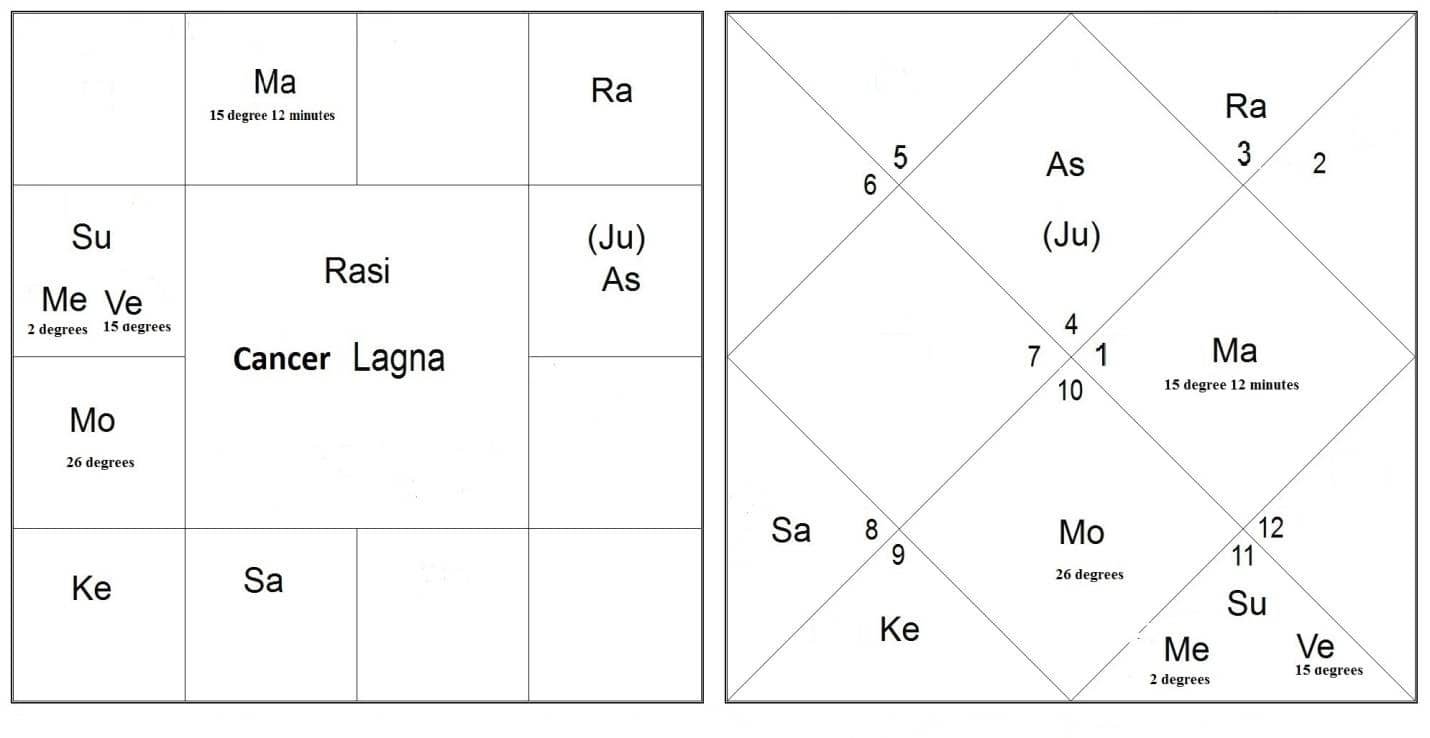
Moon 26 degrees Capricorn Mercury 2 degrees Aquarius
Venus 15 degrees Aquarius Mars 15 degrees 12 minutes Aries
Moon at 26 degrees in Capricorn, though not aspecting Mercury in Aquarius which is slower than Moon, as Mercury is 6 degrees ahead of Moon, thus within the orb of influence of Moon, therefore there is Itthshāla between Moon and Mercury. Again Venus has 3rd house aspect on Mars and is 12 minutes behind Mars who is slower mover than Venus who is relatively faster mover thus being in both aspect and within one degree so not only is this Itthshāla but Poorna Itthshāla.
Now we shall look at Isārapha/Musaripha yogas in the next chart. Here we can see that Moon a fast moving planet is within 3 degrees of Mercury in the same bhāva but it has more degrees (29) than Mercury (26), thus Mercury will never catch up with Moon and thus this is an Isārapha/ Musaripha yoga. Similarly Mars in 15 degrees, though aspecting Venus (15 degrees 12 minutes), Mars being a slow mover, though within 12 minutes of Venus the fast mover, the aspect being separating aspect, yoga thus caused will qualify to become Isārapha/ Musaripha yoga.
Essence of Prashna Techniques
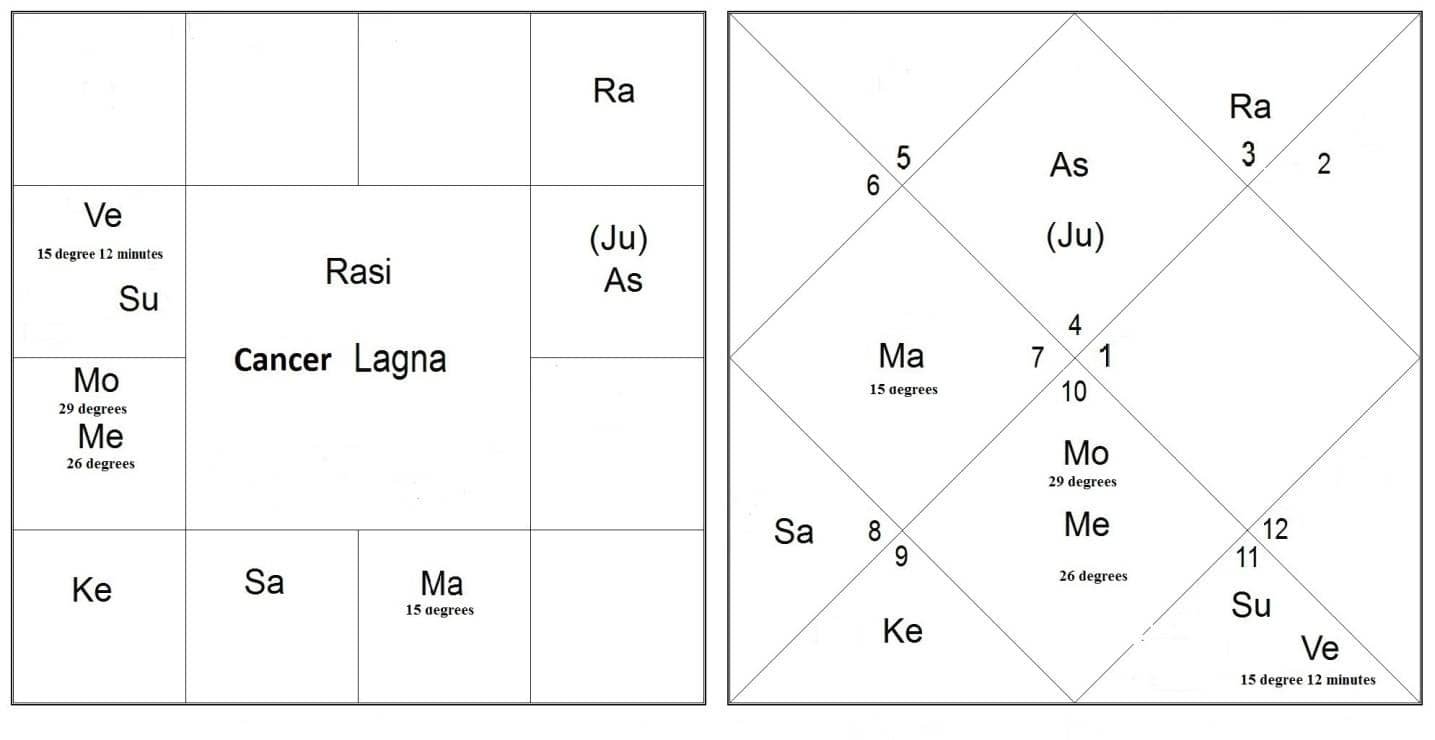
Moon 29 degrees Capricorn Mercury 26 degrees Capricorn
Venus 15 degrees 12 minutes Aquarius Mars 15 degrees Libra
We must remember that though in Tajik system of astrology, there are 16 different yogas, in Prashna part of Tajik not all are used. Itthshāla/ Muthashila, Isārapha/Musaripha and Kambool (also sometimes called Kabool) yogas (formed with Moon) are the yogas that are predominantly used in Tajik system of Prashna.
Kambool yoga is formed when the Lord of the lagna and Lord of the bhāva about which query is made (called Kāryesha) are in Itthshāla yoga and Moon also is in Itthshāla with one of them. Depending on whether the planets involved in Kambool with Moon, and Moon itself, are in exaltation it is called Uttam Kambool and so on, till Moon not being strong the yoga is called ordinary Kambool. It is obvious that if Moon is in Itthshāla with both Lagnesh and Kāryesha and in strength it will be the most powerful of the Kambool yogas. Results of this yoga are good. An example of Kambool/ Kabool yoga is given below.
Here we have to understand that in Tajik, 9th bhāva is primarily related to travels, dug water wells, pilgrimages, temples and religion etc. while 10th with work of father.
In the next example, the question being about travel or pilgrimage, the planets involved will be Venus as Lagna lord and Mercury as lord of the 9th. They do have aspect between them and Mercury being in 14 degrees is behind of Venus in 18 degrees. Moon with 10 degrees is in aspect with both of them and within DeeptāMsha and therefore this comes under the definition of Kambool yoga and the query will fructify.

Moon 10 degrees Cancer Venus 18 degrees Cancer
Mercury 14 degrees Aries
Here what is more important is Moon having Itthshala with at least one of the planets who are having Itthshala between them to grant strength to the yoga. This also indicates the importance of Moon in Tajik system of Prashna, and Prashna system in general. As astrologers get more interested in learning about this system of astrology they will find many yogas that indicate good results if both Lagna and Moon are gaining strength, and that is natural as the query itself arises in mind and Moon is also the child (relevant in balariishta), so early resolution of query will naturally be influenced by its strength.
Next to be understood is the concept of the planets concerned not being in direct aspect but another planet having aspect with both, placed between the two, and being within DeeptāMsha of both the planets and thus being capable of transferring the influence (called Tej) of one planet to another. In such a case also, the results are realized but through agency of someone representing the planet which transfers the influence. There are two types of such yogas called Nakta and Yamayā. In the former the planet between the two is a planet that is faster than the two, while in the later it is slow mover than the two unaspecting planets. An example of Nakta yoga is given below.

Moon 8 degrees Sagittarius Jupiter 12 degrees Pisces
Mercury 10 degrees Leo
Here, let us assume the question is about marriage of the querist. The querist as we know is represented by Lagna and the Lagna lord Mercury a fast mover is in 10 degrees, while the would be spouse will be represented by the 7th bhāva whose lord is Jupiter, a slower moving planet in 12 degrees, so in right degrees for an Itthshāla, however there is no aspect between them. However Moon who is faster than both the planets and in lesser degrees that both of them is between the two and aspects Mercury by 9th house aspect and simultaneously Jupiter by square aspect. He is also within DeeptāMsha of both of them. Now here comes the concept of transference of power or energy/ Tej. Here Moon in 8 degrees takes the energy of Mercury (another relatively faster planet) and passes it on to Jupiter, the slowest amongst the three planets, thus giving rise to Nakta yoga. This will therefore indicate that the object of the query shall be achieved through agency of a third person. Moon being karaka for mother and a female planet, gain of spouse will be through agency of mother or some female.
Let us now understand how the Yamayā yoga operates. This yoga, as we have already learnt, has its basis on a slower moving planet than those not aspecting each other, coming between them and aspecting both being within the DeeptāMsha of both, thus being able to transfer the Tej (energy/influence) from the faster moving (amongst the two non aspecting planets) to the slower planet, thus leading to achievement of the object of query. We shall see how this occurs in the example chart below.
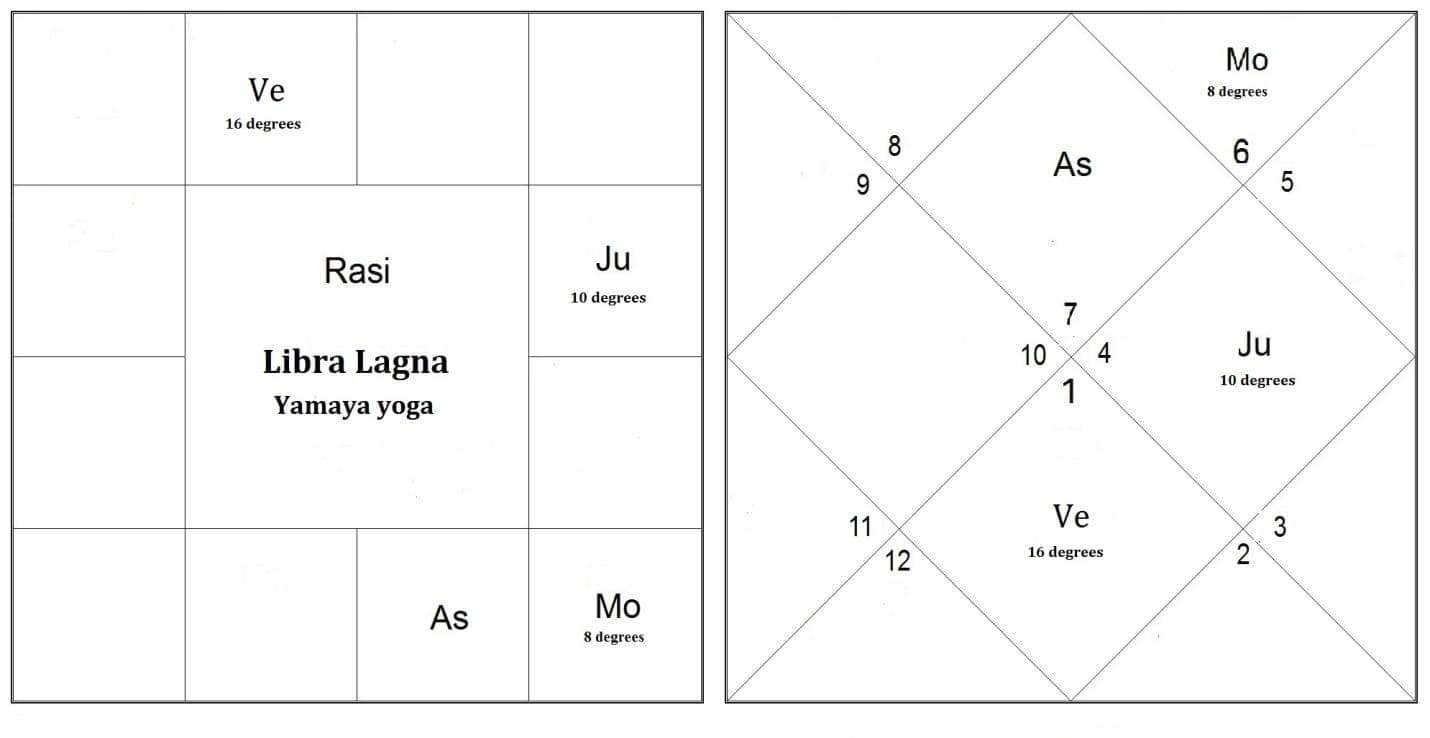
Moon 6 degrees Virgo Jupiter 10 degrees Cancer
Venus 16 degrees Aries
Here the question being of gaining kingdom or position of influence or promotion at work, the Lagna lord Venus (Lagnesh) and the 10th lord Moon (Kāryesha as the question is about recognition (Man) or Kingdom (Rajya)), both of which are represented by the 10th bhava, are the planets that should ideally be aspecting each other, for enough strength in the yoga to grant the desired object. However though Moon with 6 degrees and Venus with 16 degrees are within deeptamsha (orb of influence) they do not aspect each other. However we can see that Jupiter who is with 10 degrees and slower than both is aspecting both the planets (by 10th and 3rd aspect respectively) and being between the two can get the Tej from Moon, who is behind him and pass it on to Venus whom he aspects and who is ahead of him, thus indicating fructification of the query. We can see here that Jupiter only operates as the transfer of influence of Moon to Venus. Now as Jupiter represents a minister or secretary, the object of desire will be realized through agency of minister to king or someone who is at senior position in management (in case of promotion) can be predicted.
The crux of analysis of Tajik method of Prashna is finding out the correct Bhava which is related to the query and after analyzing the Lagna, as indicated earlier. One should come to a conclusion only after finding out if the Lagna lord and Karyesh aspect own or each others house or each other and if they are in Itthashala or Musaripha. It is a good idea to find out the strength of yoga indicated by looking at whether the Lagna is Chara, Dwisvabhava or Sthira as then something happening, happening with some trouble and thing remaining static would be indicated. Sheershodaya lagna will add to the strength. And finally look for good yogas between the Lagnesha and Karyesh (the lord of the bhava relevant to query) and their fortification or otherwise by Nakta, Yamaya or Kamboo yogas, to finally arrive at the answer to the query.
Here we should also understand that though the square aspects are generally inimial, in case of benefics the malfeasance is fairly reduced and if simultneously yoga for fructification is there and should Lagnesha and Karyesh be aspecting each other, each other’s house or own house, the result will be good, even if on a bit reduced scale.
Astrologers have a different opinion on how to determine when the results will be obtained, in case of absence of Poorna Itthshala. The general guide line is that the difference in degrees between the Lagnesha and Karyesha in Itthashala will indicate the time. Some opine that in case of Chara rashis being involved in Lagna one should say the difference of amsha indicates days, Dwivabhava rashis shall indicate weeks and Sthira rashis indicates month. Some learned are of the opinion that the navamsha past (ie each rashi consists of 9 navamsa’s) in Prashna lagna are the best indication of when the object of the query will fructify and especially in case of question from a pregnant lady that does seem logical. However, all this should be applied with a sense of proportion, based on the type of query and not by rote.
There are many yogas and types of questions that can be answered using both the Daivagya Vallabha or the Tajik approach, but the most important thing is understanding of bhavas in depth and then the desire to answer the question through Prashna that will dictate the accuracy or otherwise of the prediction. I would urge the astrologers interested in learning this branch to read as much text on the subject as possible and try to understand the underlying principles before making a firm prediction only from Prashna. I generally base my predictions on natal chart, but resort to Prashna when the urge to look at Prashna gets hold of my mind on hearing some query and even after that I analyze the natal chart to be certain that answers of both converge before venturing out with the prediction. However, there are many who predict solely on the basis of Prashna and there is nothing wrong in that approach.
I would have liked to write more on the subject but then paucity of space and time both prohibit me from doing so and I trust the readers will understand this. If one really wants to write on Prashna at great depth, that would mean writing a separate book on this and that is not the mandate of this web site which is for those who already have some basic knowledge of astrology and want to know more on less commented and elaborated upon, aspects of Vedic astrology. So I close this article on Prashna here and hope this helps astrologers who read it.
Regards,
Chandrashekhar Sharma
www.JyotishTeachings.com
copyright © 2015 Chandrashekhar Sharma
Note: This Article is Originally published at @ http://www.jyotishteachings.com/articles.html
Users can Buy : Books Authored by Chandrashekhar Sharma
Vedic Astrology Demystified is now available on Amazon in both Kindle and
paperback format
Link for same is : Vedic Astrology Demystified

Views: 1964
No comments yet — be the first to share your thoughts or ask a question!
Discussion & Questions
Be the first to commentAll questions and perspectives are welcome. We read and respond to every comment personally.
Never Miss a Research Article
Subscribe to Vedic Wisdom Journal — classical Jyotiṣa, Mundane Astrology & Vedic science delivered to your inbox.
- ✦ Planetary transit alerts & celestial forecasts
- ✦ Nakṣatra analyses & Dāśā research
- ✦ Mundane Astrology event analyses
- ✦ No spam · Unsubscribe any time
You'll receive new Vedic Wisdom Journal articles in your inbox.

✦ Leave a Comment